Build Grip Strength After 50 for Everyday Independence
You can improve hand grip strength after 50 with gentle resistance exercises, gradual progress, and time for your hands to recover. Those small efforts support everyday independence, whether you’re opening a jar, carrying groceries, or enjoying an afternoon in the garden.
I’d begin with a comfortable starting point, then build a routine that fits the life you already have.
Key Takeaways
- Grip strength gives clinicians useful information about overall muscular strength and healthy aging.
- A dynamometer measures grip strength. Household tasks can reveal changes, but they can’t give you an accurate score.
- Start with gentle towel squeezes, controlled wrist movements, and light carries twice a week.
- Allow about eight to 12 weeks of consistent practice before judging your progress.
- Pain, tingling, or unexplained weakness deserve medical attention, especially when symptoms are new.
- Grip exercises work alongside whole-body strength, balance practice, adequate food, and recovery.
Why Grip Strength After 50 Deserves Attention
Cleveland Clinic describes grip strength as the most widely used measure of overall muscular strength in older adults, as cited by SilverSneakers. Grip is a broad functional biomarker of aging, not a diagnosis, and weaker results are associated with frailty. Geriatric specialist Dr. Ardeshir Hashmi says grip strength decline can begin around 50.
Strength often peaks earlier in adulthood, so these timelines describe different stages. Muscle mass may decline roughly 1% annually after 50, although individual changes vary.
What the Health Studies Show
The 2015 PURE study findings involved nearly 140,000 adults across high-, middle-, and low-income countries. Lower grip strength predicted mortality more strongly than systolic blood pressure.
SilverSneakers also reports that the 2022 Long Life Study followed more than 5,000 older women for roughly five years. Stronger grip was associated with lower all-cause mortality, independent of weight change, and researchers use such findings to study longevity.
These are associations. They don’t show that squeezing a ball extends life expectancy or replaces diagnosis or treatment for chronic diseases.
Why Bones and Balance Belong Here
A review of grip strength research connects weaker grip with falls, fracture risk, lower bone density, and poorer cognitive function. Studies also associate weaker grip with dementia, but research doesn’t show that hand exercises prevent cognitive decline.
After menopause, low grip can accompany osteoporosis risk and lower bone density at the hip and spine. A grip test can’t diagnose osteoporosis.
Forearm and wrist strength may help you support yourself during a stumble, but they don’t guarantee protection from hip fractures. I’d pair hand work with balance exercises for women over 50.
Find a Useful Starting Point

How a Dynamometer Test Works
A dynamometer measures how firmly you squeeze, usually in kilograms or pounds. A common clinical approach uses three trials per hand and records the highest reading, although protocols differ.
The clinician adjusts the handle and standardizes your position, often with your elbow bent around 90 degrees. Rest between attempts helps prevent fatigue from distorting the result.
For repeat tests, use the same device, position, and scoring method. Your trend is more useful when the testing conditions stay consistent.
What the Numbers Mean
Fitness author Joan Pagano gives these broad reference ranges for adults ages 50 to 59.
| Age | Sex | Grip Strength in Pounds | Grip Strength in Kilograms |
|---|---|---|---|
| 50 to 59 | Women | 45 to 75 lb | 20 to 34 kg |
| 50 to 59 | Men | 85 to 115 lb | 38 to 52 kg |
These aren’t universal diagnostic boundaries. Body size, hand dominance, pain, equipment, and testing technique all affect the reading.
Published age-specific grip strength research shows why comparisons should account for age and sex. A score below a reference range deserves interpretation, rather than an automatic label of poor health.
At home, notice changes in familiar tasks without testing yourself to exhaustion. Repeatedly dropping a mug or struggling with a previously manageable handle is worth mentioning at an appointment.
Start With a Gentle Home Grip Routine
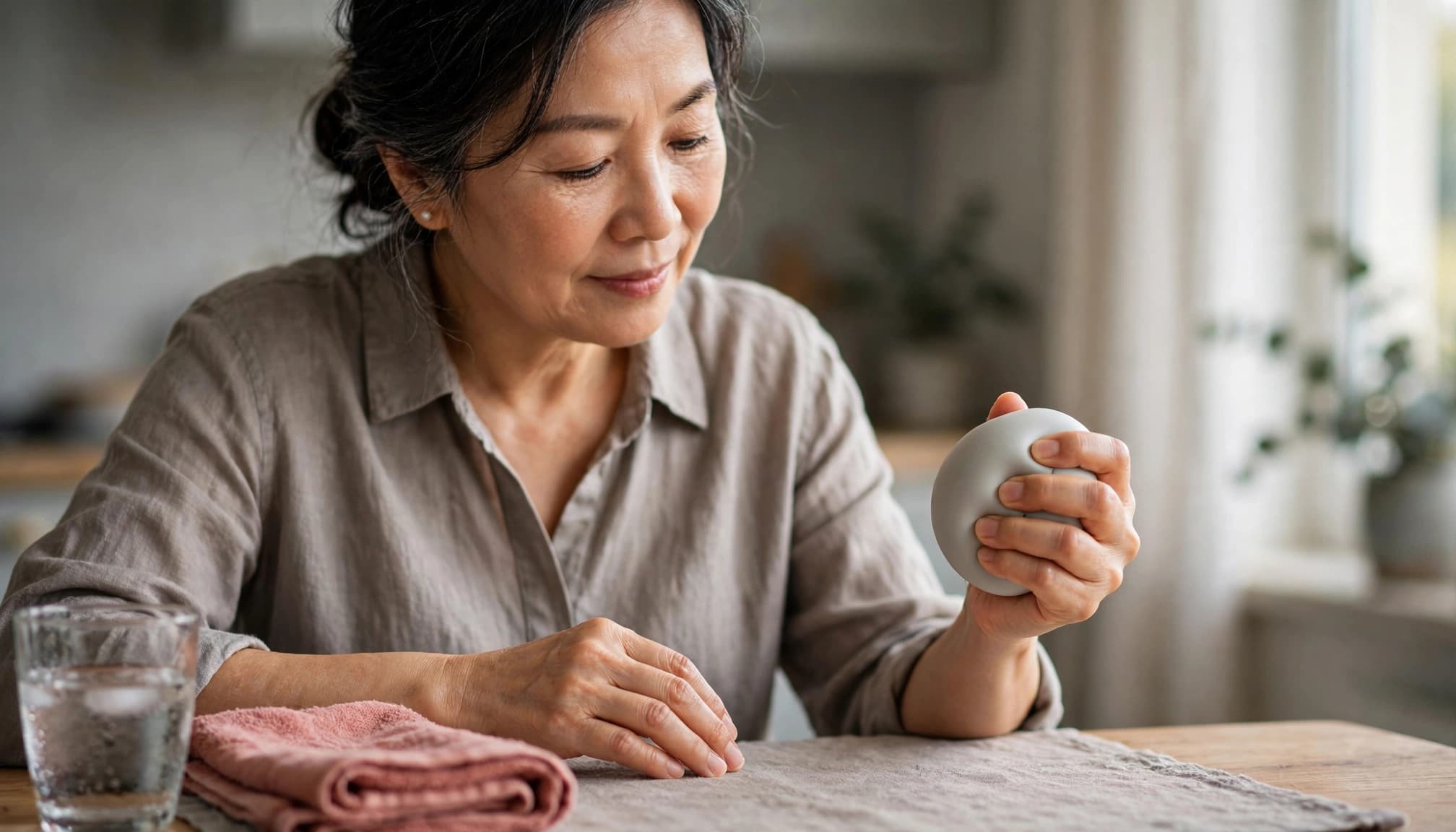
Before starting, talk with your doctor or physical therapist, especially if you have arthritis, osteoporosis, hand pain, or a recent injury. The right starting resistance should feel manageable without joint pain.
Begin twice weekly, with at least one rest day between sessions. Warm up by opening your hands softly and making small, comfortable wrist circles.
These movements build hand and forearm strength for tasks such as carrying groceries and opening containers.
These are conservative starting amounts, not targets you have to finish.
| Movement | How to Do It | Starting Amount |
|---|---|---|
| Towel squeeze | Squeeze a rolled washcloth gently, keeping your wrist straight. This is an isometric hold, a gentle contraction without movement. | Hold 3 seconds; repeat 8 times per hand. |
| Grip and release | Close your hand into a comfortable fist, then open fully without forcing. | 10 slow repetitions per hand. |
| Gentle towel wringing | Twist a dry towel lightly in opposite directions; skip this if twisting hurts. | 5 repetitions each direction. |
| Supported wrist curl | Rest your forearm on a table, palm up; lift and lower your hand slowly. | 1 set of 10 per side, initially without weight. |
| Farmers carry | Walk with two equally light, balanced bags at your sides along a clear, level route. | 2 rounds of 10 to 20 seconds. |
Keep breathing throughout each movement and stop before your grip gives way. Rest between exercises, and reduce the amount if your hands ache afterward.
SilverSneakers recommends three sets of 10 wrist curls, alongside wrist circles, soft fist opening and closing, hammer-curl pulses, and biceps curls. Its timed movements generally run 20 to 30 seconds; you can build toward those amounts as tolerated.
Build Strength Without Rushing Your Hands

Give Progress Several Weeks
Physiotherapy guidance commonly suggests allowing about eight to 12 weeks for noticeable improvements with regular practice. Weakness related to inactivity can improve, while nerve, tendon, or joint problems may need treatment.
Dr. Hashmi recommends squeezing a racquetball or squash ball for at least 10 minutes twice daily. I’d approach that volume cautiously, especially with sensitive joints, and begin with the shorter routine above.
Cleveland Clinic also encourages at least 10 minutes of daily exercise and emphasizes doing something consistently. Daily movement can include walking and gentle mobility while your hands recover between harder sessions.
As exercises become comfortable, progress your resistance training by changing one thing at a time: add a couple of repetitions, a few seconds, or slightly more resistance. Keep a simple note of what you did and how your hands felt the following morning.
Support the Rest of Your Body
Your hands benefit when your whole body gets stronger. My at-home strength training routine starts with two nonconsecutive days and movements such as chair stands and wall push-ups.
Food matters here, too, because muscle needs nourishment as well as a reason to work. My guide to protein needs after 50 can help you make room for that support.
If remembering another habit feels like a lot, my free Self-Care Journey Starter offers a gentle place to organize your intentions. Attach hand practice to something familiar, such as finishing breakfast.
Know When Your Hands Need More Support
Muscle effort should ease after you stop. Pause and seek medical advice for new or persistent sharp pain, swelling, tingling, numbness, locking fingers, or worsening weakness. Tingling or numbness can have several causes, including carpal tunnel, so ask a professional to assess them rather than guessing.
Arthritis can make forceful gripping uncomfortable, and towel wringing may aggravate painful joints. A hand therapist can adapt resistance, movement, and equipment to your needs.
Sudden weakness in one hand or arm, especially with facial drooping or speech trouble, needs emergency care.
Please don’t explain persistent symptoms away as another birthday. Getting help early can make everyday tasks more comfortable and identify a treatable cause.
I see this kind of attention as part of caring for the body that carries you through your day. My Ultimate Self-Care Guide offers broader support for making that care a regular part of life.
For injury prevention while your hands get stronger, use both hands for heavier items, divide grocery loads, and take breaks during repetitive gardening or kitchen work.
Frequently Asked Questions
Do Hand Grippers Work Better Than a Towel?
A hand gripper can provide adjustable resistance, but you don’t need one to begin. A soft ball or rolled washcloth offers a simple starting point, especially when a stiff gripper feels uncomfortable.
Choose resistance you can control through a comfortable movement. More resistance isn’t helpful if it makes you hold your breath or strain your joints.
Should Both Hands Be Equally Strong?
Your dominant hand is often stronger, so a small difference can be normal. The size of that difference depends partly on your activities and whether you’re right- or left-handed.
A new or growing difference deserves attention, particularly if it comes with pain or numbness. Avoid forcing the weaker hand to match the stronger one during practice.
Is Using a Jar Opener Giving Up on Strength?
Absolutely not! A jar opener, wider utensil handle, or lighter kettle can reduce strain while you continue building strength.
I encourage you to use whatever makes daily life safer and more comfortable. Helpful tools and exercise can sit comfortably alongside each other.
Keep Your Hands Ready for the Life You Love
Improving grip strength after 50 starts with manageable practice, enough recovery, and attention to what your hands are telling you. The useful result is more freedom and functional independence in daily activities like carrying, cooking, and gardening.
Choose one comfortable exercise and give it a place in your week. Small, steady efforts can help keep the things you love within reach.